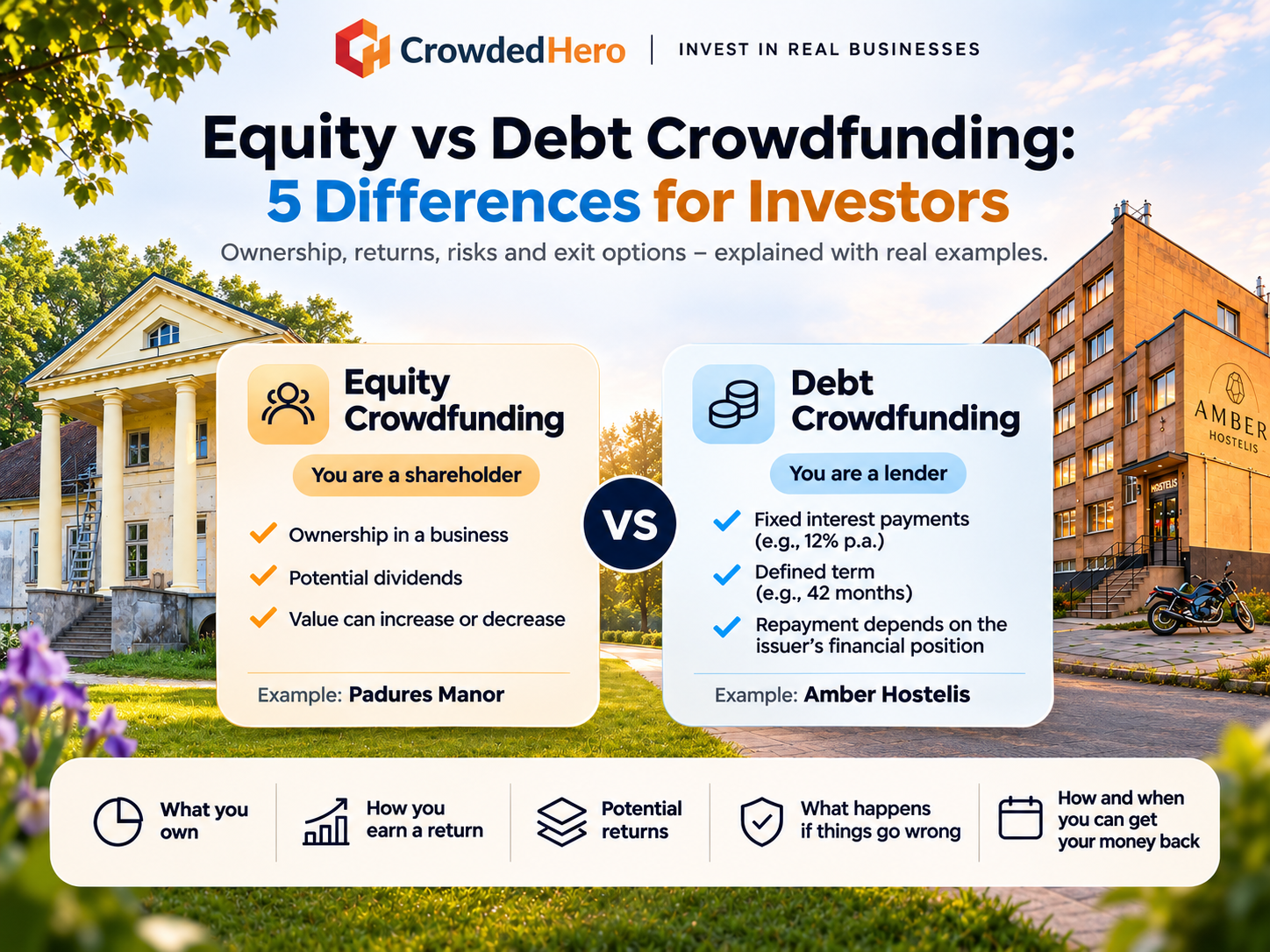
Equity vs Debt Crowdfunding: 5 Differences for Investors
Equity crowdfunding makes you a shareholder. Debt crowdfunding makes you a lender. Both allow you to invest in businesses, but what you own, how you might earn money and when you can get it back are very different.
Before choosing either, it helps to understand five differences that directly affect your investment.
What is equity crowdfunding?
With equity crowdfunding, investors provide capital to a company in exchange for shares or an ownership interest, sometimes held indirectly through a special purpose vehicle (SPV).
Your investment's value depends on how the business performs. You might receive dividends if profits are distributed, or realise a gain if you can eventually sell your shares at a higher price.
Neither outcome is guaranteed.
Real example: Padures Manor, Latvia
Padures Manor is raising equity capital to continue restoring a historic manor and developing its hospitality business.
In its third funding round on CrowdedHero, one Class B share costs €450.
Investors participate in the company's future, but there is no fixed annual payment or guaranteed date when they can recover their capital.
Explore the Padures Manor project
What is debt crowdfunding?
Debt crowdfunding works differently. Instead of buying ownership, you lend money to a business, often by purchasing bonds.
The investment terms specify an interest rate, payment schedule and maturity date. The issuer is contractually obliged to make the agreed payments, but its ability to do so depends on its financial position.
A fixed interest rate does not mean a guaranteed return.
Real example: Amber Hostelis, Latvia
Amber Hostelis is raising financing through digital bonds to develop its accommodation business in Liepāja.
Its offering specifies:
-
12% fixed annual interest rate
-
Quarterly interest payments
-
42-month bond term
-
€500 minimum investment
The scheduled payments depend on the issuer meeting its obligations. Investors could lose part or all of their capital.
Explore the Amber Hostelis project
Five differences that matter to investors
1. What do you actually own?
Equity: You hold shares or an indirect ownership interest in a business. Your financial outcome is linked to the value and performance of that business.
Debt: You are a creditor. You hold a contractual claim to interest and repayment rather than an ownership stake.
That distinction affects your rights, your risks and what happens if the company experiences financial difficulties.
2. How do you earn a return?
Equity: Potential returns generally come from dividends and an increase in the value of your shares. A profitable company may still choose not to distribute dividends, depending on its obligations and governing documents.
Debt: Interest is calculated according to the bond's terms. Payments may be quarterly, semi-annual or follow another schedule.
For example, a bond with a 12% annual coupon would accrue €120 of annual gross interest on €1,000 of principal, assuming the stated calculation basis and a full year of accrual. Actual payments depend on the offering documents and the issuer meeting its obligations.
3. How much could you earn?
Equity: There is no predetermined fixed return. A successful business could increase substantially in value, but it could also lose value or fail completely.
Debt: The contractual coupon is defined in advance. Unlike a shareholder, a bondholder does not automatically participate in additional profits if the company grows faster than expected.
Neither structure guarantees a positive investment result.
4. What happens if the business fails?
Both types of investment carry a risk of losing your entire capital.
If a company becomes insolvent, shareholders generally rank behind creditors when remaining assets are distributed.
Bondholders may have a higher claim than shareholders, but the actual repayment priority depends on the bond conditions, security arrangements and applicable insolvency rules.
Some bonds are subordinated, meaning other creditors have priority.
Even a creditor with a legally enforceable claim may recover little or nothing if the issuer has insufficient assets.
Debt crowdfunding is not automatically a low-risk alternative to equity crowdfunding.
5. How and when can you get your money back?
This is one of the most overlooked differences.
Equity: Shares generally have no maturity date. You may need to wait for a dividend, company sale, buyback or opportunity to transfer your shares.
Debt: Bonds have a contractual maturity date, when the issuer is scheduled to repay the principal. But repayment depends on the issuer remaining able to meet its obligations.
Neither investment necessarily allows you to withdraw money whenever you wish.
Private crowdfunding investments can be difficult to sell. Even where a bulletin board or another transfer mechanism exists, it does not guarantee a buyer or a sale at your desired price.
If you may need your money at short notice, consider that limitation before investing.
Which type of crowdfunding fits your goals?
There is no universally better option.
Before deciding, ask yourself three questions:
Do I prefer a defined payment schedule or exposure to a company's long-term growth?
A bond provides agreed contractual terms, while equity participation depends more directly on the company's future value and potential dividends.
How long can I leave this money invested?
Both shares and bonds may tie up capital for years, without a reliable opportunity to sell early.
Can I afford to lose the invested amount?
Consider the potential impact of a complete loss on your finances. Diversification may help manage concentration risk, but it does not eliminate investment risk.
What should you check before investing?
Whether you are considering shares or bonds, start with the platform and the specific offer.
CrowdedHero is an EU-regulated crowdfunding service provider, licensed and supervised by the Bank of Latvia (licence No. 06.15.01.806/120).
Investor payments are handled through Lemonway, a payment institution authorised in France.
Before publishing investment opportunities, CrowdedHero assesses companies against its selection requirements, including operating history, financial information, ownership structure and business plans.
However, regulatory supervision, payment arrangements and project assessment do not guarantee investment performance.
You should still review:
-
The company's financial statements and obligations
-
How the investment proceeds will be used
-
The terms of the shares or bonds
-
Expected dividend or interest arrangements
-
Potential conflicts of interest
-
Exit and transfer restrictions
-
The Key Investment Information Sheet (KIIS), where applicable
Crowdfunding investments are not covered by bank deposit guarantee schemes or investor compensation schemes.
Compare current crowdfunding opportunities
Frequently asked questions
Is crowdfunding equity or debt?
It can be either. Equity crowdfunding involves acquiring an ownership interest, while debt crowdfunding involves lending capital under agreed repayment terms. Some platforms, including CrowdedHero, offer both.
Do you get your money back from crowdfunding?
There is no guarantee. Bonds normally provide for principal repayment at maturity, but the issuer may default. With equity, recovering your investment generally depends on dividends or successfully selling your interest.
Is equity crowdfunding riskier than debt crowdfunding?
Risk depends on the individual investment, not just its structure. Both can result in a total loss. Bond ranking, security, issuer finances and equity valuation all matter when evaluating an offer.
Can I sell my investment before maturity?
Not necessarily. Private crowdfunding investments often have limited liquidity, and a buyer may not be available. Review the specific transfer conditions before investing.
Compare the opportunities, then decide
CrowdedHero offers investors access to different types of European business financing, including company shares and bonds.
The most important step is understanding what you are buying, what you could earn, what might go wrong and how long your money may remain invested.
Updated November 2026.
Risk warning: Investing involves risk, including the possible loss of part or all of the invested capital. Past performance does not guarantee future results. This article is for informational purposes only and does not constitute personal investment advice.