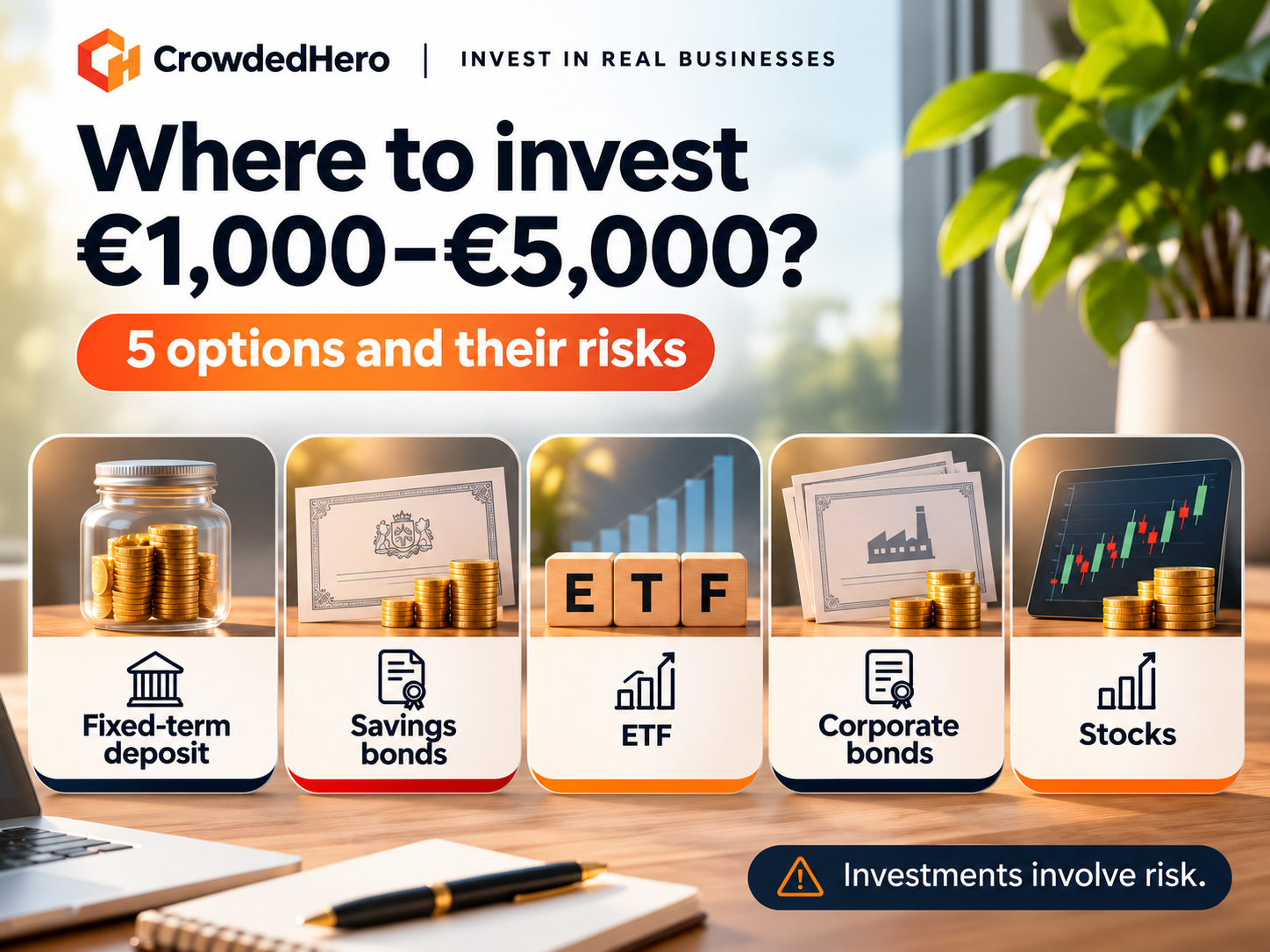
Where to Invest €1,000–€5,000: 5 Options and Their Risks
Have you saved €1,000, €2,000 or €5,000 and are wondering what to do with the money?
There are several possibilities, ranging from bank fixed-term deposits and government savings bonds to exchange-traded funds (ETFs), corporate bonds and company shares.
The potential return is not the only difference. It is just as important to understand how long your money will be tied up, how easily you can access it and what happens if an investment does not perform as expected.
Let's look at five investment options, their advantages and their risks.
Before investing: Three questions to ask yourself
First, consider what you intend to use this money for.
1. Do you have an emergency fund?
If €2,000 represents your entire savings, consider setting aside money for unexpected expenses before investing. A car repair or job loss is not the ideal moment to be forced to sell your investments.
2. When will you need the money?
Money you plan to use in six months requires a different approach from capital you can leave invested for five or ten years.
3. How much can you afford to lose?
Different financial instruments carry different risks. Some may experience fluctuations in market value, while others involve the possibility of not recovering even the original investment.
1. Bank fixed-term deposits
A fixed-term deposit is one of the simplest ways to manage savings.
You deposit a certain amount with a bank for a specified period, such as three, six or twelve months. In return, the bank pays interest at the rate agreed in the deposit contract.
Advantages:
-
A known interest rate and deposit term.
-
Relatively straightforward conditions.
-
Eligible bank deposits in Latvia are protected up to €100,000 per depositor per bank.
Risks and limitations:
Early withdrawal may be restricted or result in the loss of interest. Inflation can also reduce the real purchasing power of your money if prices rise faster than the interest you earn.
Fixed-term deposit rates vary between banks and can change over time. It is therefore worth comparing current offers before entering into an agreement.
2. Latvian government savings bonds
Government savings bonds are securities offered to individuals by the Latvian State Treasury.
When you purchase these bonds, you are effectively lending money to the Latvian government for an agreed period in exchange for interest determined at the time of purchase.
In Latvia, government savings bonds can be purchased from €50. Different maturities are available, ranging from a few months to several years.
Advantages:
-
The interest rate is fixed at the time of purchase.
-
Repayment obligations are guaranteed by the Latvian state.
-
Interest income from Latvian government savings bonds is exempt from personal income tax.
-
Early redemption is possible under the applicable conditions.
Risks and limitations:
Like other sovereign debt instruments, government savings bonds carry sovereign credit risk, although Latvian savings bonds benefit from a state guarantee.
If you choose early redemption, you may lose some or all of the interest previously received. Government savings bonds cannot be freely sold to another investor.
Check current interest rates and purchase conditions at krajobligacijas.lv.
3. Exchange-traded funds (ETFs)
An exchange-traded fund, or ETF, allows you to invest in shares of multiple companies or other financial instruments by purchasing units in a single fund.
For example, a fund tracking a broad global equity index may hold hundreds or thousands of companies.
Even with €1,000, it may be possible to gain broader market exposure than by buying shares in just one or two individual companies.
Advantages:
-
The opportunity to diversify across many businesses.
-
Many ETFs can be bought and sold during stock exchange trading hours.
-
Exposure to different regions, industries and investment strategies.
Risks and limitations:
ETF values can fluctuate significantly. During a downturn in global equity markets, substantial losses are possible, and there is no guarantee that prices will recover when you need your money.
You should also consider management costs, brokerage fees, potential currency exposure and the concentration of the fund's investments.
An ETF may be tradable, but that does not mean you can always sell it without a loss.
4. Corporate bonds
When you purchase corporate bonds, you become a creditor of the issuing company.
Unlike shares, bonds generally have a specified interest rate, payment schedule and maturity date.
Corporate bonds may be available both on regulated markets and through certain crowdfunding offerings.
Real example: Amber Hostelis
On CrowdedHero, SIA BALVORA Group offers digital bonds to finance the development of Amber Hostelis in Liepāja, Latvia.
The offering terms provide for:
-
A fixed annual coupon of 12%.
-
Quarterly interest payments.
-
A bond term of 42 months.
-
A minimum investment of €500.
If a bond has a nominal value of €1,000 and an annual coupon of 12%, the gross interest calculated over one full year would amount to €120, assuming the applicable interest calculation basis.
However, these interest payments are not guaranteed profits.
Advantages:
-
Contractually defined interest rates and payment dates.
-
The opportunity to finance a specific business and its development plans.
-
Access to different issuers and bond structures.
Risks and limitations:
If a company encounters financial difficulties, interest payments or principal repayment may be delayed or fail to occur.
Unlike a bank fixed-term deposit, these investments are not covered by a deposit guarantee scheme.
Privately issued bonds may have limited liquidity. For example, Amber Hostelis digital bonds do not have an active secondary market, and restrictions apply to their transfer.
It is therefore particularly important to read the bond terms and the Key Investment Information Sheet before investing.
Explore the Amber Hostelis project
5. Investing in shares of private companies
Another option is to become a shareholder in a private business.
Unlike bonds, shares do not provide contractually fixed interest payments. Potential returns depend on the growth of the company's value, dividend distributions or the possibility of selling the shares in the future.
Real example: Padures Manor
On CrowdedHero, Padures Manor is raising financing to restore its historic property and develop its hospitality business.
In its third funding round, one Class B share costs €450.
The investment provides an ownership interest in the business under the offering terms, but it does not offer a fixed annual return.
Advantages:
-
The opportunity to participate in a company's long-term development.
-
Potential returns from dividends or an increase in share value.
-
The possibility of investing in a specific business whose activities you can follow.
Risks and limitations:
The company's value may decline, dividends may never be distributed, and unsuccessful business operations could result in the loss of the entire investment.
Shares in private companies often have no active trading market. Investors may have to hold them for several years without being able to sell quickly.
A share buyback is not guaranteed unless binding provisions exist. Even then, there remains a risk that the relevant obligations will not be fulfilled.
Explore the Padures Manor project
How do these five options compare?
| Investment type | Main risk | Access to your money |
|---|---|---|
| Fixed-term deposit | Inflation and early withdrawal restrictions | Depends on the agreement |
| Government savings bonds | Sovereign credit risk and potential loss of interest upon early redemption | Early redemption subject to conditions |
| ETF | Decline in market value | Generally tradable on an exchange |
| Corporate bonds | Issuer default and limited liquidity | Depends on the offering |
| Private company shares | Business failure and illiquidity | Often a long-term investment |
How could you allocate €2,000?
There is no single formula suitable for everyone.
For example, someone wishing to combine several investment types could theoretically allocate €2,000 as follows:
-
€500 in a fixed-term deposit.
-
€500 in government savings bonds.
-
€1,000 in a broadly diversified ETF.
This is only an illustrative example, not a recommendation to follow this allocation. It also does not mean such a distribution would be suitable for someone without an emergency fund.
Another investor might consider corporate bonds or private company shares, provided they are prepared to accept additional risks and a longer period during which their capital may be tied up.
The central principle is to avoid exposing all your capital to the risks of a single company, sector or investment instrument.
How can you check an investment platform?
Before investing, make sure you understand who provides the service and how it is regulated.
CrowdedHero is a European Union-licensed crowdfunding service provider supervised by the Bank of Latvia (licence No. 06.15.01.806/120).
Investor payments are processed by Lemonway, a licensed payment institution.
Before projects are published, CrowdedHero assesses companies' financial information, operating history, ownership structure and business plans.
However, a regulatory licence and project assessment do not mean that an investment will succeed or that your capital will necessarily be repaid.
You should also examine the specific offering documents, the company's obligations, the intended use of funds and any restrictions on selling the investment.
Frequently asked questions
Where can I invest money to earn interest?
Fixed-term deposits, government savings bonds and corporate bonds can provide interest income.
However, their risks and repayment conditions differ significantly. A fixed interest rate does not always mean that the expected payments are guaranteed.
Can I start investing with just €1,000?
Yes. Various investment instruments can be purchased for €1,000 or less.
For example, the minimum investment in Latvian government savings bonds is €50, while the minimum amounts for individual CrowdedHero projects are specified in their offering documents.
Are CrowdedHero investments covered by a deposit guarantee scheme?
No. Crowdfunding investments are not bank deposits and are not covered by bank deposit guarantee schemes or investor compensation schemes.
How long could my money remain invested?
This depends on the investment instrument.
Fixed-term deposits, government savings bonds and corporate bonds usually have a specified term. Shares in private companies may have no defined maturity date at all.
The ability to sell an investment before maturity is not guaranteed.
Before making your decision
If you have €1,000–€5,000 to invest, the first question should not be where you can earn the highest return.
It is more important to understand how much risk you are prepared to accept, how long you can leave your money invested and whether you might need it to cover unexpected expenses.
Compare the terms, read the risk disclosures and do not make an investment decision based solely on the advertised interest rate.
Explore CrowdedHero investment opportunities
Updated November 2026.
Risk warning: Investing involves risk, including the possible loss of part or all of your invested capital. Past performance does not guarantee future results. This article is for informational purposes only and does not constitute personalised investment advice.